Interpreting Bangor from a Bicycle
Shopping centres and semiotic Assemblages
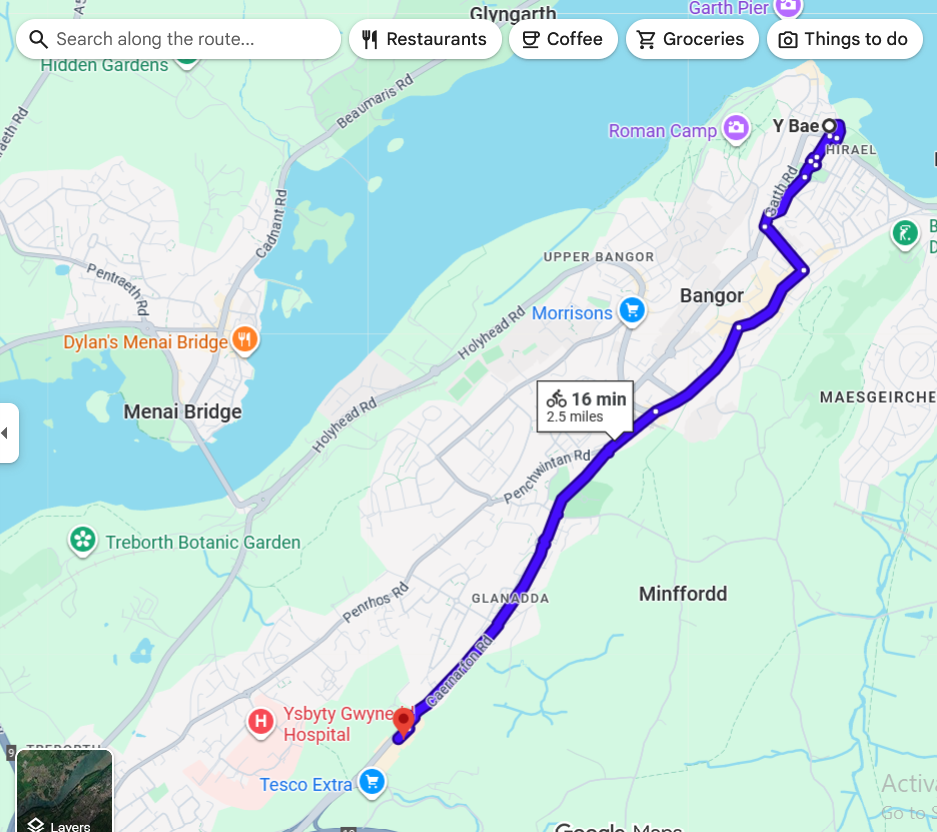
It is 9.40 on June 25th, 2026, and I have to be in a Teams call at 10.30. Yesterday I bought a wireless lapel mic from Argos for this research and it turned out to be entirely unworkable so I am returning it. It is an amber heat warning, red in many parts of the UK, yet another reason to be quick. This morning I was reading about semiotic assemblages (Pennycook 2017 cited in Pennycook, 2019, 219) and it appears very relevant to this research. This comes up in the field of linguistic landscapes (LL). Whereas LL has traditionally focussed on language on signs in public places, semiotic assemblage focusses less on the intended meaning and more on the interpretation of the landscape and its components as language (Pennycook, 2019). This appears close to my plan to read the landscape of Bangor using ecolinguistics methods. So I set out to Argos with the term semiotic assemblage on my mind, and no working means to record my field notes. Here is what I remember.
Some of the time I was on the main roads and some of the time on the Lon Adda active travel route. With two exceptions, the parts of the journey on the main road did not align with the ecosophy of this research (described later in the post). Fast, narrow main roads with many roundabouts create a semiotic assemblage that made me feel unwelcome on my bicycle. The first exception is the cheeky detour I can take through the ASDA car park that cuts off two sides of a triangle, has no fast traffic and avoids a hill. Nothing in the signage suggested that this was intentional on the part of the designers, but in Pennycock’s second form of linguistic landscapes the focus is on how the landscape is interpreted it, and I was very happy at that point! The second point where the main road aligned with my ecosophy was when I saw 20mph signs. The target of much wrath, they are a top-down measure aimed at increasing road safety by keeping traffic speeds down. It meant that cars were expected to go at a similar speed to me on my bicycle (I was in a hurry) and this meant I felt safer and welcome on this otherwise hostile space.
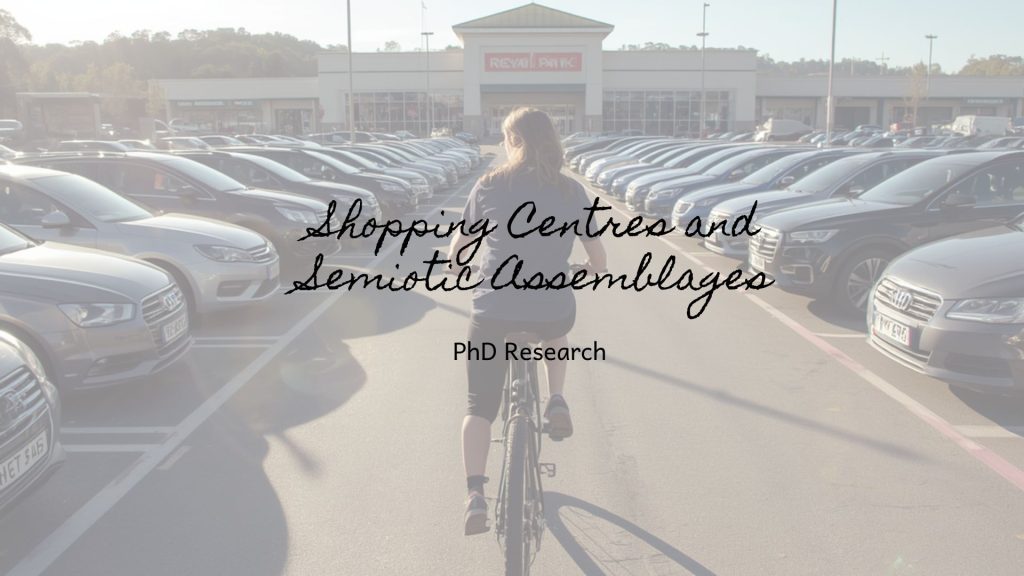
On my arrival at Argos, which is situated in a retail park I read the semiotic assemblage in the following way. Firstly, the location is 2 miles from the centre. This fact alone does not align with my ecosophy as it signals that you need to travel by car to buy electronics at Argos, clothes from Next or even a bicycle from one of Bangor’s two bike shops which are located nearby! Second, there was a big car park and most of the spaces were full. I had to lock my bike to a signpost. I felt a negative emotion here. Why? It was a very practical place to lock my stead. At the same time, however, I felt that it negated the possibility that anyone would come shopping here on a bicycle. That the Lon Adda was purely a route for people to cycle out of Bangor for leisure activities. I would have interpreted a bicycle rack similar to someone saying ‘hello and welcome’ as I arrived. Sadly, the signpost did not carry this message for me.
On the way back I spent more time on the Lon Adda. Some traffic free sections, green areas with playgrounds, football pitches and plenty of trees made a welcoming landscape, soundscape and even smellscape. At times it takes a roundabout way, and is hillier than the main road. I interpreted this all more positively, although there was a disconnect between my hurried utility cycling and the semiotics of leisure. I still felt good except for one large problem. The Lon Adda rejoins the main road just as the main road narrows to go under the railway bridge that separates the centre from the Caernarfon Road retail parks. It feels very ad hoc, and dangerous. It is not safe for anyone, with a disproportionate impact on children, inexperienced cyclists and others. To add insult to injury, there is a well-intentioned sign that the very narrow pavement with pedestrians is marked as a cycle lane. I made the mistake once of trying to cycle on it! At the same time, my wife has been hooted at by drivers because she was on the road and they thought she should be on the ‘cycle path’. Incidentally hooting like that is not permitted in the highway code whereas choosing not to use a cyclepath is permitted!
This ride was one of the more challenging routes in Bangor. Yet it is also a transport artery that anyone who needs to buy certain things must use. The layout of Bangor here is a challenge, with the distance between the retail park and the centre, the railway bridge being a bottleneck and the intermittent nature of the Lon Adda cycle route. I experienced several negative emotions at these points. At the same time, there were several occasions when the semiotic assemblage of traffic free sections, greenery and the urban furniture of leisure facilities had a positive emotional impact, making me feel a part of the landscape that fitted in, and was in line with the ecosophy of this research.
Interpreting Bangor from a bicycle: Background
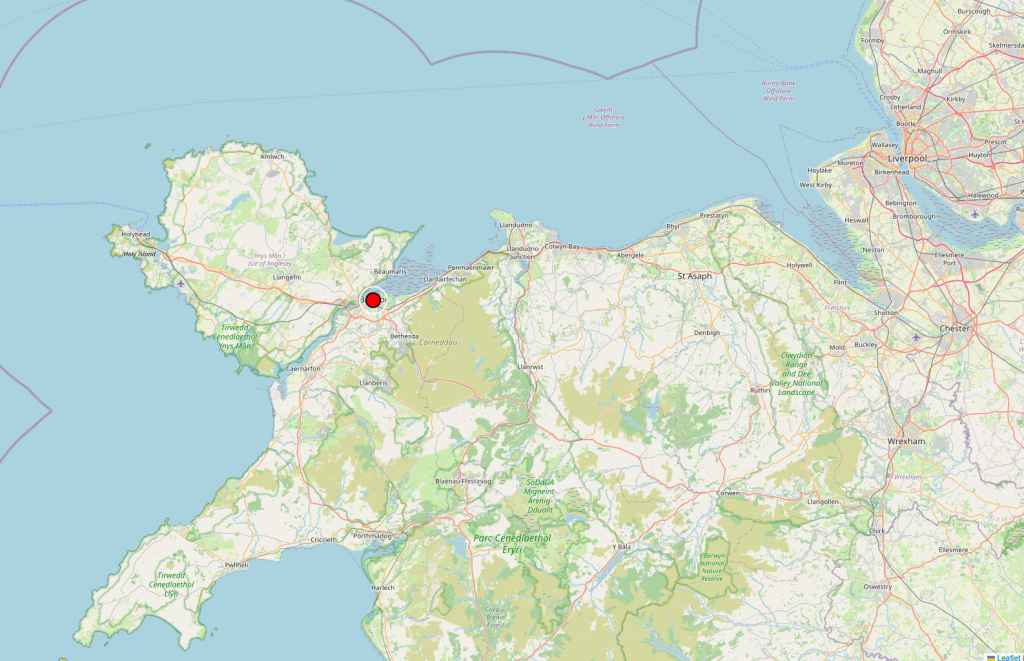
I’m Owain, and I’m doing my PhD on the interpreting Bangor from a bicycle. This research takes place in Bangor, Gwynedd. Bangor is a small city with a university and a cathedral and it is located between Eryri, or Snowdonia, and the Afon Menai, or Menai Straits, an arm of the sea separating Ynys Mon, or the Isle of Anglesey, from the mainland.
Which part of Bangor am I reading as a text?
While interpreting Bangor from a bicycle, I have selected roads to read in an area based on two things. One of these is a circle around Bangor City cathedral. This circle has a radius of 1.2 miles. The second is routes that I use for utility cycling that are outside of this circle. By utility cycling I mean the use of a bicycle for a purpose beyond seeking the pleasure from riding a bicycle. This includes commuting, shopping, school runs and so on. I also includes leisure activities that have another purpose, such as going to a cafe or a trip to a nice place, or cycling to the dinghy park to take out my sailing boat.
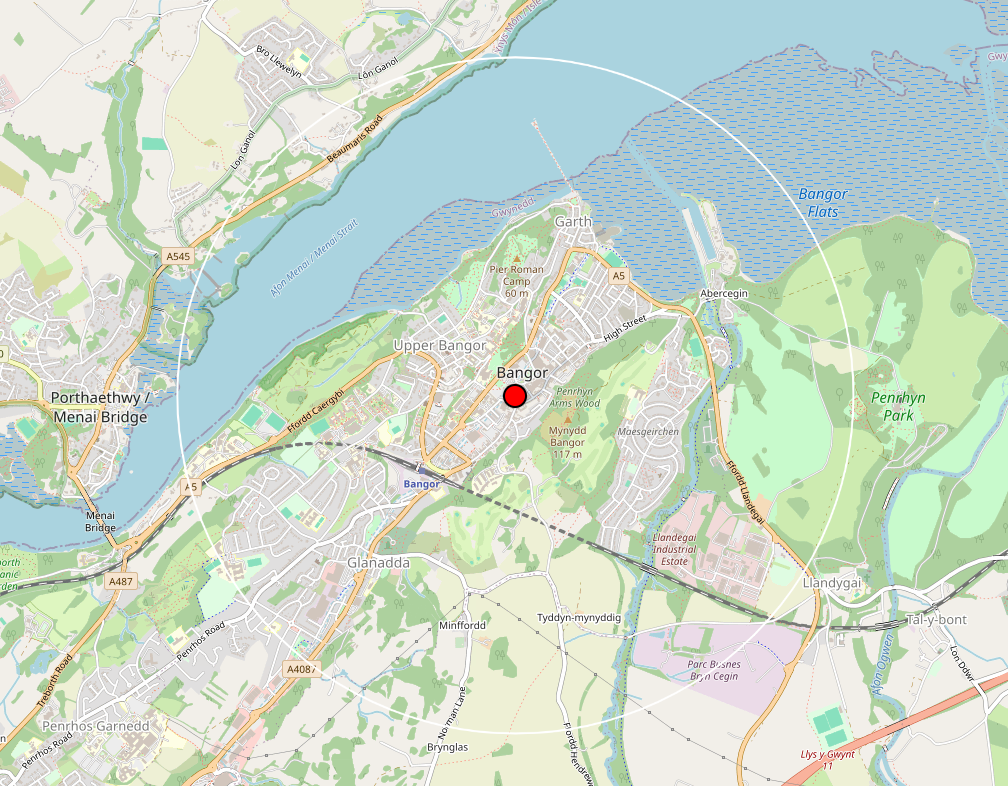
To make the map with a radius I used Free Map Tools
Ecosophy
Ecosophy
The ecosophy of this research recognises the importance of the individual, the community and the more than human world. Regarding the individual, social justice and space equity are important, so individuals should be able to safely and conveniently use active and ‘green’ modes of travel without the sense that they are going against the grain of the urban design. There should not be disproportionate amounts of space allocated to users of certain modes of travel at the expense of others, especially if the mode has strong negative externalities such as road safety issues or pollution. Mobility should enhance health and well-being and avoid negative health and well-being impacts on others. Regarding the community, mobility should not cause excessive air and noise pollution, infrastructure should avoid separating people and communities from each other and enable urban space to be safe, with accessible public spaces that encourage social interaction. For the more than human world, it is vital to ensure mobility is not pushing us beyond environmental limits, and furthermore an intrinsic value is placed on this sphere and the species within it. Discourses that encourage cycling, as well as other forms of active travel such as walking or skating, align with this ecosophy because they are healthy activities, they do not have an excessive infrastructure footprint, they have social benefits and low environmental costs. Discourses which are anti-cycling or promote car travel oppose this ecosophy and therefore will be considered as destructive discourses. This includes the human-designed environment, such as road layouts. The ecosophy will be refined during the research and the research will use a rubric to map the texts against the ecosophy.
References
Pennycook, A. (2019). The landscape returns the gaze: Bikescapes and the new economies. Linguistic Landscape, 5(3), 217–247. https://doi.org/10.1075/LL.18027.PEN

[…] In my research I read Bangor as a text using echolinguistic analysis techniques, with an autoethnographic methodology. This means using the self as an instrument of research. An important part of this takes place while riding a bicycle. The focus is on going to the places I need to go in Bangor, or “utility cycling”. I will do the research from a bicycle and write follow up blog posts. […]
[…] bobs, I might be better to rush down Beach Road running parallel to it. This will be more like the ride to the retail park on Caernarfon Road. If my children want to cycle or scate on the promenade, I should probably escort them across the […]