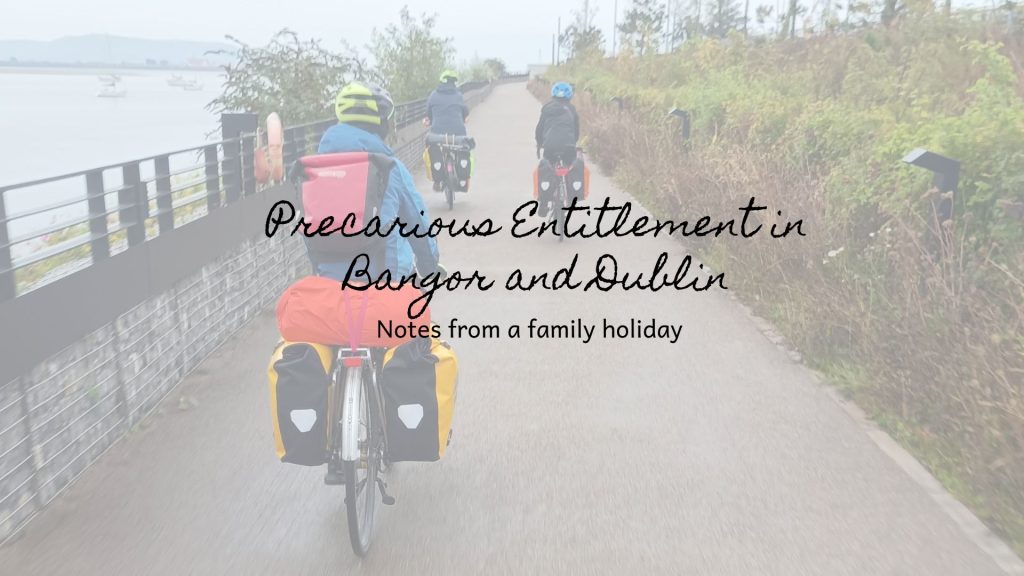
Precarious Entitlement in Bangor and Dublin
What's precarious entitlement?
Robert Egan is an Irish academic who has coined a term that is influential in the literature on urban cycling: precarious entitlement (2021a). It refers to the fact that in theory, cyclists enjoy the legal right to utilise the public space of the road, in practise this right is precarious, because of their vulnerability, the fact that other road users contest their right to this space, and furthermore road designers, police and authorities may not adequately defend cyclists’ rights to this space. His research took place in Dublin so it was with some trepidation that I made the final preparations for our family holiday, a cycling tour which would take us into the very heart of the Irish capital.
Early on a Sunday morning in mid-August, we wheeled the bicycles out and loaded them up. Gwyneth, aged 11, is still on a child’s bicycle yet she has a set of panniers. Philip, aged 14, packs a fully loaded touring bike with panniers front and rear and Krissy and I are loaded up like pack horses. We’ll spend the next two weeks cycling, camping and staying in hotels as we make our way along the royal canal from Dublin into the centre of Ireland.
Bangor half-asleep on a Sunday morning
We set off through the silent streets of an early Sunday morning in Bangor to the train station. A lumbering herd of cyclists with neon panniers, it is hard to imagine our passing going unnoticed, yet there is almost no one about. Another idea I read in Robert Egan’s work comes to mind: provoking responsibility (2021b). This is when cyclists take measures to oblige other road users to recognise the entitlement of the cyclist to the public space of the road. They do this in several ways, including by accentuating presence. Unintentionally, we have done this. As a group of cyclists, we are a more visible and unyielding occupier of the public road space than a lone commuter cycling to work. The presence of children, one hopes, stimulates greater care on the part of other road users, and the hulking, neon-panniered bikes have a certain presence. Is it the solemn presence of pilgrims making their pious way to some far-off destination?
A gentle gradient from Bangor seafront to the train station to catch the train to Holyhead ferry port, passing the leisure centre, a youth centre, parks, the bus station, an art gallery, Pontio Arts and Culture Centre, major supermarkets and the High Street. Once again, I notice how all the major spaces of the city are a short bicycle ride away, and it surprises me again that people say Bangor is too hilly to ride. On this silent morning, Bangor seems like the ideal 15-minute city: flat, compact and traffic free. There is a continuity between these spaces, rather than the disconnect created by roaring traffic and lengthy waits to cross the road.
The slightly rocky cycle into Dublin
With the short train journey and the pleasant ferry crossing, Bangor and Dublin feel like sister cities across the water from each other. Riding out from the ferry port we take. a cycle route along the shores of the Tolka River Estuary that Dublin Port Authority has built. People said hello and welcomed us as we rode into Dublin. Information boards presented the wildlife and history of the area, and the pristine tarmac swept us past industrial facilities on one side and seabirds and yachts on the other. The GPS led us off this route towards our hotel. A cycleway of cracked tarmac narrowed between lampposts and metal fencing. We could barely cross the cycle crossings before the little green bicycle turned to red. We found the busy thoroughfares and cycle routes along the River Liffey. We found the hotel, and it looked great, only the polite man at check in told us that we were booked into their other branch, quite a distance away on the other side of the River Liffey in the Liberties quarter. Off we set again. Philip and Gwyneth, a little distrustful of my directions after previously arriving at the wrong hotel, set off on their own way across the River Liffey, disappearing into the crowd.
Reunited, we carried on. The lights turned at the next crossroads and I was caught, a car length of bicycle and touring trailer in a narrow gap. Should I block the cycle lane coming at right angles rather than block the tram? Probably! “Sorry brother” a man on a bike called as he squeezed past me as I waited for the lights to change. He saw a gap and set off. It seemed the lights were more advisory than mandatory. The bicycle light went green and I set off, only to slow right down and stop as pedestrians, sensing weakness, flooded across the cycle lane. Philip is finding great amusement at the various types of road crossing people do and categorising them: The diagonal march over a crossroads, the weave behind the gridlocked tram or the herd of pedestrians’ charge! We edged forward, so that the last of our party was not caught in the middle of the road. Open cycleway ahead! Soon after it disappeared into the road, but I followed the cyclist ahead who seemed to know what he was doing. I’m overwhelmed by how many people cycle in Dublin, and how much cycle infrastructure there is compared to when I was last here. Then I sidled into a combined bus and cycle lane, but felt great uncertainty as it went up a hill and bus after bus had to overtake. We morphed into pedestrians (hard with loaded bikes) and rejoined a cycle lane. A minibus hooted at me as it joined the road and wanted the space of the cycle lane to complete its turn. “Bloody outrageous” shouted Krissy from behind. With an engineering background, she likes things to operate more like a Swiss clock. I have the feeling that cycling, while prominent in Dublin, is still bedding in, and I must confess I’m finding it a little exhilarating! Every type of cyclist is in view; delivery riders on batmobile-inspired e-bikes, earnest young commuters on high-end hybrids, and people in t-shirt and jeans riding their pub-runners. A tired family on touring bikes pulled into a hotel.
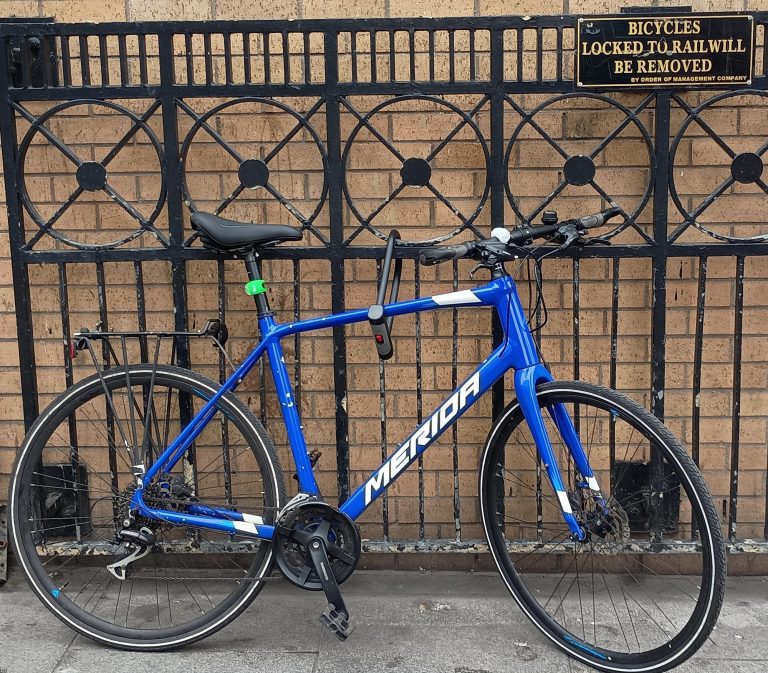
Meeting the man behind the term precarious entitlement
The next day I walked over to meet Robert Egan. The pavements are wide and crowded, and people on their Monday morning business fly by on bikes on the adjacent cycle lanes. Robert has the toned look I’ve seen among academics in the field of cycling and is very friendly. I have the faint sense of guilt of someone on holiday taking the time up of someone who’s just got through Monday morning at work. He gets two coffees and the conversation gets going. I learn that Dublin has taken a great step forward in terms of cycling since the pandemic as temporary cycle paths became permanent. Cycling through Dublin, I felt the precarious entitlement that he writes about, as I also do most days cycling in Bangor. Yet I also felt the exhilaration of being part of something new and exciting. As he mentioned, and I also saw, now there are traffic jams of bicycles, disproving the argument that money is wasted on bicycle lanes that no one uses. Dublin invites one to get on a bicycle and go where you need to go. It may be a helluva ride, but an engineer somewhere has been busy in the background, and there are some top notch, sensitively designed bicycle lanes. One of my favourite features was the separate lane that turns left off the main cycle route, and then lines you up at the road crossing, so you’ll be in time to catch the little green bicycle and cross the road, without getting in the way of other cyclists.
A final thing piece of advice he gave me that I’m grappling with was find a way to speak to engineers. While I am confident that an ecolinguistics approach to reading the city as a cyclist is valuable, conveying it in a language that those who might design and build future cycle infrastructure is vitally important and I am still searching for a way that I might articulate a message to such an audience. Early Sunday morning, Bangor conveyed a different message. Quiet, flat and compact, it invited cycling, it was interconnected rather than disconnected. It was another vision of how Bangor could be and there were few people around to witness it. If Bangor is to become more like this, it will need similar engineers to those who’ve brought such change to Dublin, and I want to share my reading of Bangor and Dublin with them.
References
Egan, R. and Philbin, M. 2021. Precarious entitlement to public space & utility cycling in Dublin. Mobilities 16(4), pp. 509–523. doi: 10.1080/17450101.2021.1913067.
Egan, R. 2021. ‘Provoking responsibility’: The struggle for recognition as an everyday cyclist in Dublin City. Geoforum 127, pp. 23–32. doi: 10.1016/j.geoforum.2021.09.012.

[…] was proving to be a challenge, and we faced a tough ride one the Royal Canal Greenway after leaving Dublin. Gwyneth was delighted when all I could find was the swanky Glenroyal Hotel. The next morning, […]